
Surprising stat to start: on many exchanges, more than half of realized trader losses come from margin or leverage moves, not spot mistakes. That matters because OKX packages familiar spot markets alongside margin, staking, a DEX aggregator, and high-leverage futures — all under one roof. For a U.S.-based trader deciding whether to log in and trade on OKX, the real question isn’t just “can I trade?” but “which mechanism fits my objective, what are the hidden trade-offs, and how do I protect myself across custody, login, and execution?”
This piece is an analytical tour: how OKX structures spot, margin, and futures; the operational trade-offs U.S. users should weigh; the security and regulatory boundaries that shape real risk; and a short decision framework you can reuse when choosing between spot, margin, or derivatives. Where appropriate I’ll flag limits and show what to watch next, including a recent, routine delisting that illustrates exchange housekeeping in action.
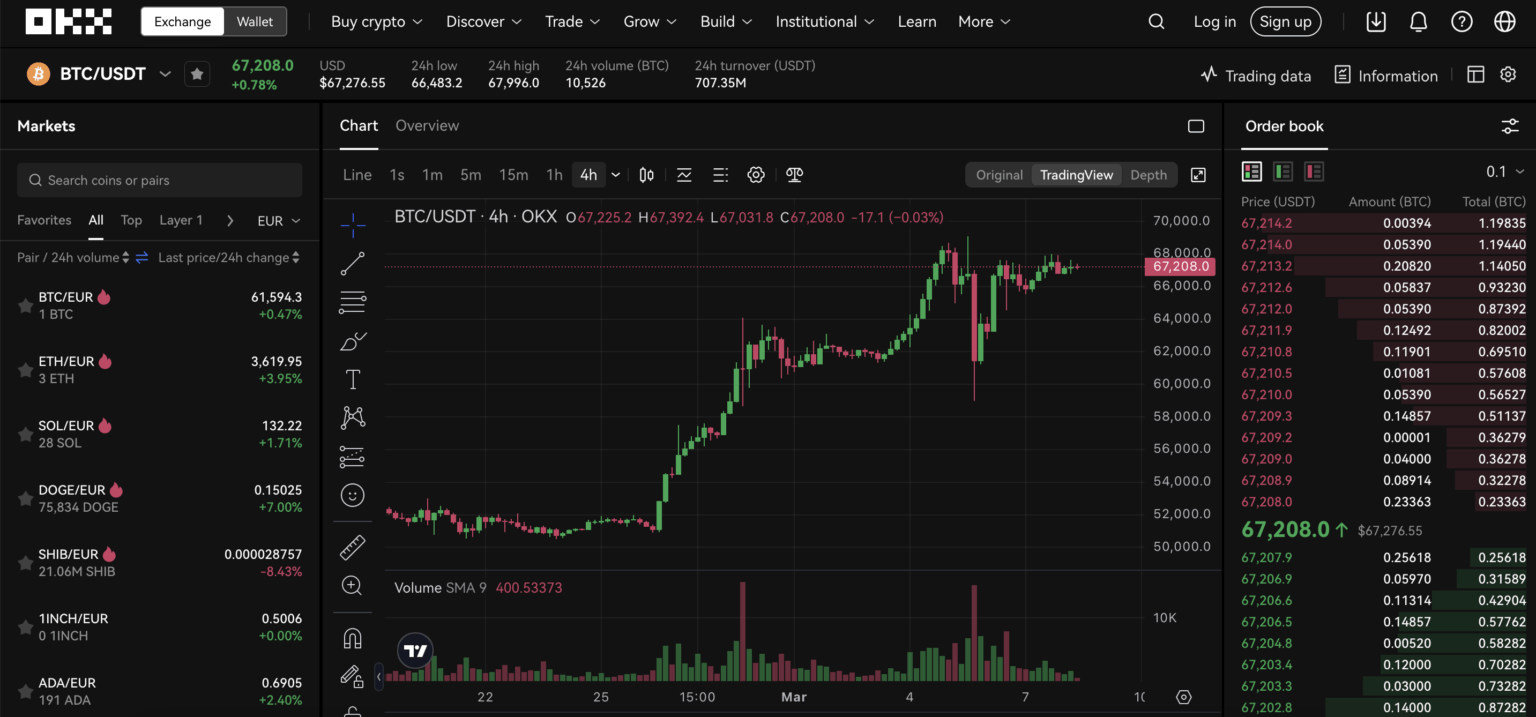
How OKX stitches together spot, margin, and futures — the mechanism
Think of OKX as three overlapping systems: a centralized exchange core (order books, matching engine, custody), a wallet/DeFi layer (self-custodial wallet, DEX aggregator, staking), and a derivatives engine (perpetuals, quarterly futures, options). Mechanically, spot trades execute against order books at market or limit prices. Margin trades borrow against collateral to increase exposure (up to 10x on OKX, in cross or isolated margin modes). Futures use a separate margin and P&L settlement system, where perpetuals include funding-rate transfers and futures have expiry-settlement mechanics. Each system uses different risk controls: initial/maintenance margins for margin and futures, liquidation engines for leveraged positions, and separate wallets/subaccounts for isolating risk.
These separate engines are linked operationally — your custody choice (custodial on OKX versus self-custodial wallet) determines whether the exchange can liquidate or move collateral in real time. OKX keeps over 95% of custodial assets in cold, multi-signature wallets, and provides Proof of Reserves transparency. But that protection is only for assets held on-chain by the exchange; interact with DeFi, and your risk shifts to smart contract security and private-key management.
Spot trading on OKX: when it makes sense, and what you lose
Spot is the simplest tool: buy low, sell high, hold assets. For U.S. traders, OKX supports over 300 cryptocurrencies and offers TradingView charting on web and biometric login on mobile, which lowers friction for frequent checks. Spot is best when your thesis is about long-term ownership, staking/yield, or using stablecoins as a funding ladder.
Trade-offs and limits: spot gives no built-in leverage, so downside is limited to capital at risk — but it also misses the amplified gains possible with margin or futures. Liquidity varies: major pairs like BTC/USD or ETH/USD are deep, but recently OKX delisted several small-cap spot pairs such as RSS3 and SWEAT; delistings are routine housekeeping to protect liquidity and market quality, but they can strand holders in less liquid tokens and force manual withdrawals. In practice, treat small-cap listings as semi-transient: they can disappear after poor volume or governance changes.
Practical heuristic: if you plan to hold tokens for staking or participation in governance, prefer spot custody in the environment (custodial or self-custodial) that lets you access those features without compromising safety. Use OKX’s flexible staking for passive yield if you want convenience and auto-compounding; use the non-custodial wallet plus a hardware device if you value ultimate control and are comfortable with seed phrase management.
Margin and futures: power tools with precise failure modes
Margin amplifies exposure; futures allow directional bets, hedging, and pure leverage up to 125x on some perpetual contracts. Mechanically, margin borrows against spot holdings and links liquidation to the margin account; futures settle mark-to-market and use isolated maintenance margins and insurance funds to absorb defaults.
Why experienced traders use futures: precise risk controls (you can hedge an existing cash position), better execution for directional shorting, and lower funding frictions for synthetic exposure. Why novices get burned: liquidation cascades during volatility, slippage in stressed markets, and margin requirements that ratchet up when volatility spikes. The “more leverage equals more expected return” intuition ignores convex risk: liquidation truncates upside sharply and often unpredictably when markets gap.
Concrete limitation: high leverage (50x–125x) is an instrument for tactical, short-duration trades where stop discipline is enforced and slippage is budgeted. It is not a retirement strategy. As a rule, only trade leverage on assets with sufficient liquidity; for illiquid tokens funding and gap risk can create outsized losses even with modest nominal leverage.
Account security and login: practical steps for U.S. users
OKX layers protections — military-grade encryption, AI-driven login monitoring, mandatory 2FA — but security is as much about user behavior as platform controls. For U.S. users, KYC is required (photo ID, liveness checks) and enables fiat rails and higher limits, but it also means identity data is stored with the exchange. If you prefer privacy, understand that KYC is a trade-off: access and liquidity versus anonymity.
Operational login checklist: enable strong 2FA (prefer app-based like Google Authenticator or hardware keys), bind biometric login only on personal devices, and consider a dedicated subaccount for high-frequency or high-risk strategies to compartmentalize failures. If you want to use a browser extension or hardware wallet, the OKX non-custodial wallet integrates with Ledger/Trezor; use that for DeFi exposure where custody by you is necessary.
Ready to log in? Use the official access route to reduce phishing risk; for convenience and security when you’re ready to connect, find the correct entry point here: okx sign in.
Comparative view: OKX versus two alternative approaches
Alternative A — Traditional U.S. centralized exchanges (e.g., mainstream domestic CEXs): These typically provide stronger fiat on/off ramps and clearer regulatory alignment, but may offer fewer non-custodial Web3 features. Trade-off: better fiat integration and perceived regulatory safety versus less breadth in DeFi tooling.
Alternative B — Pure DeFi on-chain protocols (AMMs, DEXs): You keep full custody and access composable DeFi products, but face smart-contract risk and often worse UX for complex orders. Trade-off: ultimate control and composability versus operational friction and direct exposure to contract exploits.
Where OKX fits: it’s a hybrid. It offers custodial convenience (cold storage, PoR) plus a non-custodial wallet and DEX aggregator. That hybrid status produces unique benefits — one UI for CEX and DeFi — but also unique risks: managing the boundary between self-custody and exchange custody becomes an active decision with security and regulatory implications.
Decision framework: three quick heuristics for choosing spot vs margin vs futures
1) Time horizon test: If you plan to hold longer than several months for staking or exposure to protocol growth, favor spot (and consider self-custodial or exchange staking depending on convenience vs control). 2) Volatility budget: If you cannot tolerate a 20–40% drawdown without panic selling, avoid leverage. 3) Operational skill: If you lack strict stop discipline, preferred execution tools, and a tested liquidation plan, stay in spot; if you have position-sizing rules, a volatility-aware margin model, and contingency funding, margin or futures can be used tactically.
Remember: margin/futures are options on the underlying exposure with path-dependent failure modes. Model them as conditional strategies tied to liquidity assumptions and funding-rate dynamics, not as simple multipliers of expected return.
What to watch next (signals and near-term implications)
1) Delistings and listing activity: routine delistings — like the recent removal of a handful of small spot pairs this week — are signals about exchange liquidity thresholds. If you hold small-cap assets, monitor volume and spread metrics weekly. 2) Funding rates and open interest on perpetuals: rising OI with extreme funding is a precursor to volatility spikes and liquidations. 3) Regulatory signals in the U.S.: any change in custody rules or stablecoin policy would affect on/off ramps and KYC friction; keep an eye on enforcement pronouncements and fiat-rail partner status.
These indicators translate into actionable moves: lower leverage when funding becomes extreme, diversify custody for long-term holdings, and consider moving low-liquidity tokens to wallets where you control the seed before a potential delisting.
FAQ
Is it safe to keep long-term holdings on OKX?
Safety depends on trade-offs. OKX stores most assets in cold, multi-sig vaults and publishes Proof of Reserves, which reduces custodial counterparty risk compared with naive custody. But any custodial solution requires trusting the exchange’s operational security. If you prioritize absolute control, use a non-custodial wallet with hardware integration; if you prioritize convenience plus institutional-grade custody, keeping assets on OKX with 2FA and subaccounts is defensible. The correct choice depends on your threat model (phishing vs exchange insolvency vs personal key loss).
Should U.S. traders use futures on OKX?
Futures are powerful but technically demanding. Use them for hedging or short-duration directional trades if you understand margin ladders, funding rates, and unexpected gaps. If you’re newer or lack tested risk controls, stick to spot or small margin positions. Always size positions to survive worst-case volatility scenarios for the specific asset.
What does OKX’s DEX aggregator do, and when should I use it?
The DEX aggregator searches multiple liquidity pools across DEXs to find the best swap route and can enable cross-chain transfers. Use it when you want a best-execution swap without manual routing across networks. However, aggregation does not remove smart-contract risk; when swapping significant amounts, prefer audited pools and consider slippage settings to avoid frontrunning or sandwich attacks.
How do delistings affect trading strategy?
Delistings force a decision: withdraw to an external wallet (if supported) or trade out before liquidity thins. They are a reminder to avoid keeping most capital tied to low-liquidity pairs. Monitor announcement windows, adjust order types to minimize slippage, and keep a small liquid reserve for exit trades.
Bottom line: OKX offers a comprehensive toolset — spot depth, margin options, high-leverage futures, staking, and a hybrid custody model — which is unusually broad. That breadth is valuable, but it places a burden on traders to match instrument to intention, manage custody boundaries consciously, and plan for liquidity events like delistings. Use the heuristics above, cement them with practice in a demo or small sizes, and treat leverage as a tactical amplifier rather than a structural shortcut to returns.